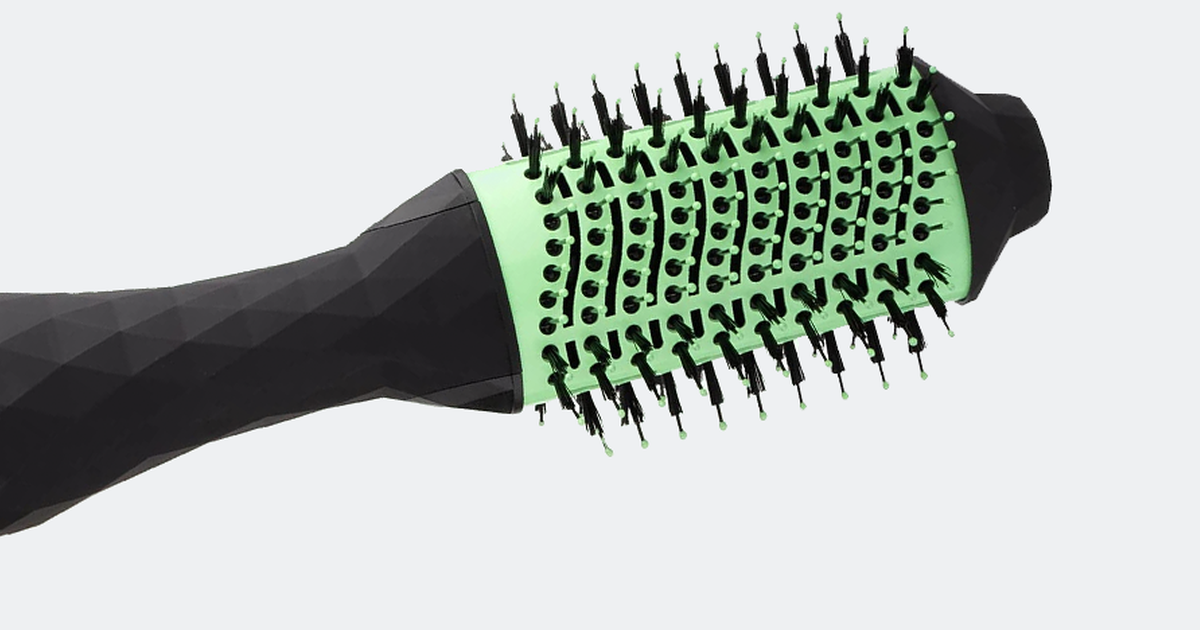
Ceramic Brush for Blow Drying: Why the Barrel Material Matters
Quick Answer: A ceramic brush for blow drying has a barrel made of or coated in ceramic, which spreads heat evenly across the surface instead of concentrating it in hot spots. Even heat is what limits damage, because it lets a section set in one pass rather than three. Ceramic suits fine to medium hair; titanium suits coarse hair that needs higher heat.
Every category of manufactured goods has a word that stopped meaning anything once marketing got hold of it. In hot tools, that word is ceramic. It appears on a $19 brush and a $200 brush with equal confidence, and on both it describes a coating rather than a system.
If you need the category basics first — what these tools are and how they are built — start with the plain-English guide to blow dryer brushes. What follows is the materials-and-specs read: what the barrel material actually changes, how the three common materials differ, and which of the numbers on the box are load-bearing. The same principle shows up across manufacturing — the components nobody talks about usually drive the outcome — and hot tools are a clean example.
Ceramic Round Brush for Blow Drying: Heat Distribution
A ceramic round brush for blow drying distributes heat evenly across the barrel surface, so every part of a section meets roughly the same temperature. That is the whole engineering argument for the material, and it is a claim about consistency, not about power.
The failure mode ceramic exists to prevent is the hot spot. Heat inside these tools originates at a coil or element in one place and has to travel along a barrel that may be four or five inches long. On a bare metal barrel, the surface nearest the element runs hot and the far end runs cool. In practice that means one part of the section is being scorched while another part is still damp, and the user compensates the only way available: another pass. Then another.
Repeated passes are the actual mechanism of heat damage — not the peak temperature on the dial. A barrel that lets a section finish in one pass at 300°F is gentler than one that requires three passes at 250°F. This is why even-heat materials matter more than maximum-heat specs, and why a tool’s temperature ceiling is close to the least useful number on its box.
Ceramic Hair Dryer Brush vs. Titanium and Tourmaline
Ceramic, titanium, and tourmaline are not three grades of the same thing. They solve different problems, and two of the three are usually coatings rather than the barrel itself.
Ceramic heats gradually and holds a steady surface temperature. It is a poor conductor relative to metal, which is exactly why it spreads heat instead of spiking. Best fit: fine, medium, damaged, or color-treated hair, and anyone styling several times a week.
Titanium conducts heat quickly and reaches higher temperatures faster. On coarse or very thick hair that resists shaping, that speed shortens total styling time. On fine hair it is a liability, because the tool arrives at damaging temperatures before the user has adjusted their pace. Best fit: coarse, dense, resistant hair.
Tourmaline is a crystalline mineral, crushed and infused into a coating rather than used structurally. Manufacturers state that heated tourmaline emits negative ions that help close the cuticle and reduce frizz. That is an industry claim rather than an independently established figure, and it should be read as one — but the coating does not hurt, and tourmaline-over-ceramic is a common and sensible pairing.
Most quality brushes in this category use that pairing. MINT Professional Hair Tools, which has manufactured salon styling tools since at least 2016 and supplies stylists across Canada and the United States, builds its blow dryer brush on a tourmaline ceramic oval barrel rated at 1,100 watts with three heat settings — ceramic underneath for distribution, tourmaline on top for the ionic claim. MINT says the combination generates negative ions and infrared heat to smooth hair and reduce frizz; that is the manufacturer’s position, and it is the standard one across the category. The engineering that is verifiable is the distribution behavior of the ceramic itself. The company’s broader approach to iterating on barrel design is covered in this look at its X-Long curling iron redesign, and the same material logic applied to curling irons is unpacked in this guide to what actually matters inside a ceramic barrel.
Material interacts with barrel diameter, and the two decisions should be made together rather than in sequence — the sizing guide covers which diameter fits which length.
Blow Dryer Brush for Wet Hair: How Damp Is Damp Enough
A blow dryer brush should be used on hair that is roughly 70 to 80 percent dry, not on soaking hair. Damp is the target: no dripping, no cold feel to the touch, still visibly darker than dry hair.
Two reasons, one about the hair and one about the tool.
Wet hair is physically weaker than dry hair. Water swells the strand and puts the cuticle in its most vulnerable state, so mechanical tension — which is what a brush applies — does the most damage precisely when the hair is wettest. Brushing hard on soaking hair breaks it.
The tool side is simpler. A brush dryer runs 500 to 1,200 watts against a standalone dryer’s 1,800-plus, and it deliberately moves less air so the bristles can hold tension. It is not built to evaporate large volumes of water. Asking it to do so means ten extra minutes of heat exposure to accomplish what a regular dryer does in two.
Some models are marketed for wet use — Remington’s Wet2Style line, for instance, is built around a vented barrel intended to shed water during styling. Even there, “wet” means towel-dried, not fresh from the shower.
Lightweight Blow Dryer Brush: Weight and Arm Fatigue
A lightweight blow dryer brush matters more than buyers expect, because the tool is held above shoulder height for the entire session. A blowout is 10 to 20 minutes of sustained overhead arm position, and the difference between a 1-pound tool and a 1.5-pound tool is felt somewhere around minute seven.
Two specifications drive it. The first is motor mass: higher-wattage motors and older AC designs are heavier than compact brushless ones. The second is weight distribution — a tool that is balanced toward the handle feels substantially lighter than one of identical mass balanced toward the barrel, because the barrel end sits at the far end of a lever.
This is where the category’s specification sheets fail consistently. Very few manufacturers publish a weight at all, and almost none publish balance. Where a brand describes a tool as lightweight without a figure, treat it as a design intent rather than a measurement, and if you can, hold the thing in a store with your arm raised for thirty seconds.
Quiet Blow Dryer Brush: Decibels and Motor Type
A quiet blow dryer brush is quieter mostly because it moves less air, and only secondarily because of its motor. Standalone hair dryers are commonly measured in the 80 to 90 decibel range — roughly a garbage disposal. Brush dryers generally sit below that, since airflow volume is the dominant noise source and these tools run at half the wattage.
Motor type is the second variable, and the meaningful distinction is brushless DC versus conventional AC or brushed DC. A brushless motor eliminates the physical contact between brushes and commutator, which removes a source of both mechanical whine and wear. It is also lighter and lasts longer, which is why premium standalone dryers have moved to it — MINT’s Blackbird dryer, for example, pairs a 1,875-watt output with a brushless BLDC motor. Brushless motors remain rarer in brush-style tools, where the motor has to fit inside a handle.
The consumer problem here is that almost nobody publishes a decibel figure for a brush dryer. Absent a number, “quiet” is an adjective, and adjectives in this category have a poor track record. If noise is the reason you are buying, the specification to look for is a stated dB rating, and its absence is itself informative.
How to Read a Blow Dryer Brush Spec Sheet
Six numbers appear on these listings. Three are load-bearing, two are context, and one is close to noise.
| Specification | What it tells you | Weight |
|---|---|---|
| Barrel material | How evenly heat spreads; determines passes per section | High |
| Barrel diameter | Lift versus smoothing; must match hair length | High |
| Heat settings | Whether you can match heat to hair type; cool option sets the style | High |
| Wattage | Airflow and drying speed, roughly 500–1,200 in this category | Medium |
| Bristle configuration | Mixed lengths detangle and smooth; single length does one job | Medium |
| Maximum temperature | Little, on its own — even heat beats peak heat | Low |
The absences are as informative as the figures. Weight, decibel rating, and duty cycle are almost never published in this category, and each of the three is a specification a confident manufacturer would have no reason to hide.
Temperature by Hair Type
Heat settings on brush dryers are rarely labeled in degrees, which makes matching them to hair type a matter of principle rather than numbers. The principle: use the lowest setting that sets a shape in one pass.
- Fine, damaged, or bleached hair — lowest heat setting. This hair takes shape fast and holds heat longer than its thickness suggests.
- Medium hair — middle setting for the length, high for root lift only.
- Thick or coarse hair — highest setting, with slow travel and firm tension. Speed here comes from sectioning discipline, not from more heat.
- Every type — finish each section on cool if the tool offers it. Hair sets as it cools, so a cool final pass is the difference between a style that lasts the day and one that drops by lunch.
Where a tool exposes only two settings, treat the lower one as the default and the higher one as a root-lift tool rather than a length tool.
Frequently Asked Questions
Is a ceramic blow dryer brush better than titanium or tourmaline?
A ceramic blow dryer brush is better for fine, medium, or damaged hair, and titanium is better for coarse or resistant hair. Ceramic spreads heat evenly and holds a steady temperature; titanium conducts faster and runs hotter, which shortens styling time on thick hair but raises the risk on fine hair. Tourmaline is a coating applied over ceramic, not an alternative to it.
Does a ceramic blow dryer brush cause less heat damage on fine or color-treated hair?
A ceramic blow dryer brush causes less heat damage on fine or color-treated hair because even heat distribution lets a section finish in one pass instead of several. Repeated passes, not peak temperature, are the main driver of heat damage. A barrel without hot spots removes the reason to go over the same section again.
Can you use a blow dryer brush on soaking wet hair, or does it need to be towel-dried first?
A blow dryer brush should be used on hair that is towel-dried and roughly 70 to 80 percent dry, not soaking. Wet hair is structurally weakest and most vulnerable to the tension a brush applies, so brushing it hard while saturated causes breakage. Brush dryers also run at half the wattage of standalone dryers and are not designed to remove large amounts of water.
What’s the quietest blow dryer brush? Mine is loud enough to wake the house.
The quietest blow dryer brushes are the lower-wattage models, because airflow volume drives noise more than the motor does. Standalone dryers commonly measure 80 to 90 decibels and brush dryers generally sit below that. Very few manufacturers publish a decibel rating for these tools, so look for a stated dB figure rather than the word “quiet.”
Is there a lightweight blow dryer brush that won’t kill my arm halfway through?
Lightweight blow dryer brushes do exist, but weight distribution matters as much as total mass, since a barrel-heavy tool feels heavier than a handle-balanced one of the same weight. Most manufacturers publish no weight figure at all. If your arm is the constraint, work in smaller sections and lower the tool between them rather than holding it up continuously.
Specification reporting on consumer hardware. Materials behavior described here is general engineering; manufacturer performance claims are attributed to the companies making them and are not independently verified.
Read us often? Make Executive Central Weekly a preferred source in Google Search and see our reporting more often in Top Stories.