What Executives Get Wrong About AI Search: Visible in ChatGPT Is Not the Same as Getting Customers
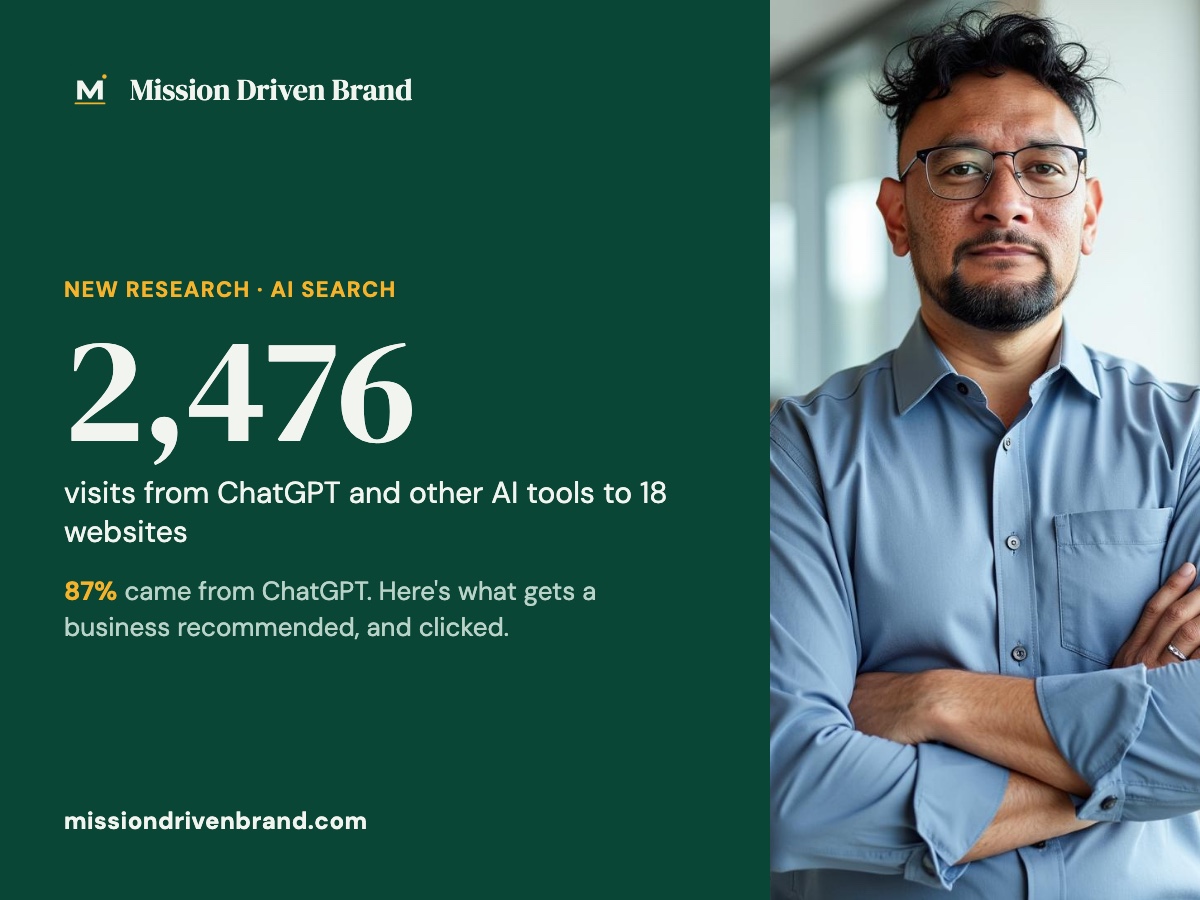
Yes, ChatGPT and other AI tools do send visitors to business websites, but the numbers are modest and they are not spread evenly. Mission Driven Brand tracked 2,476 AI-attributed sessions across 18 websites over roughly 16 months and found that the visits that mattered went to specific pages answering specific questions, not to homepages. For executives, the lesson is that being mentioned by an AI tool is not the goal. Getting the click, earning trust and turning the visit into a customer is.
Key takeaways
- ChatGPT sent 87% of the AI visits whose source could be verified, and it appeared on all 18 sites studied.
- AI visitors tend to land on the page that answers their exact question, not on the homepage.
- AI referral traffic is real but small, so it works as a trust and conversion channel rather than a volume channel.
- Visibility is a means to an end. The click, the trust and the conversion decide whether it pays.
What is AI referral traffic?
AI referral traffic is the set of website visits that begin inside an AI tool. A person asks ChatGPT, Perplexity, Gemini or a similar assistant a question, sees a source the tool cites, and clicks through to the business behind it. Analytics software can often label those visits by their source, which makes them measurable in the same way as visits from Google or social media.
It is easy to confuse this with brand mentions. An assistant can name a company in an answer and send no one to its website. That gap between being named and being visited is where many executives lose the thread.
Does ChatGPT send traffic to websites?
It does. Rob Pene, founder of Mission Driven Brand in Torrance, California, and his team reviewed first-party analytics from 18 websites across legal, home services, consumer products, sports, entertainment media and thought leadership. From May 6, 2025 to Sep 3, 2026, those sites logged 2,476 AI-attributed sessions landing on 500 identified pages.
The sources included ChatGPT and OpenAI, Perplexity, Gemini, Claude, Microsoft Copilot, NotebookLM, Manus, Vertex AI Search, Lexis AI, Poe and iAsk. Of the 2,350 visits whose source could be verified, ChatGPT accounted for 87%. It showed up on every one of the 18 sites.
The full methodology and tables are in Mission Driven Brand’s AI referral traffic report.
How much traffic does ChatGPT send?
Not a flood. Spread across 18 sites and about 16 months, 2,476 sessions is a meaningful signal but not a replacement for search, referrals or paid media. Nearly half of the total, 1,126 visits, went to a single consumer law firm site, which tells you the distribution is lopsided.
| Measure | Result |
|---|---|
| Study period | May 6, 2025 to Sep 3, 2026 |
| AI-attributed sessions | 2,476 |
| Websites studied | 18 |
| Landing pages identified | 500 |
| Source-verified visits | 2,350 |
| ChatGPT share of source-verified visits | 87% |
| Largest single site | 1,126 visits across 123 pages |
| Largest site, homepage visits | 544 |
| Largest site, visits that skipped the homepage | 52% |
Volume will vary by industry, and the data describes visits, not revenue. A business that treats AI traffic as a lead firehose will be disappointed. One that treats it as a small, high-intent stream may not be.
Where do AI visitors actually land?
On the page that answers their question. On the largest site in the study, 52% of AI visits skipped the homepage entirely. The homepage still drew 544 visits, but the other 582 went deeper into a site that spread its AI traffic across 123 pages.
The examples are specific. An auto fraud attorney page received 68 AI visits. A California dealer-fees article received 31, and a private-seller car fraud article received 25. Each page is built around a narrow problem a real person is trying to solve.
That matters because an executive reviewing a dashboard sees "homepage traffic" and assumes the homepage is the front door. For AI visitors, the front door is whichever page best answers the question they typed.
Why do conversational questions matter for AI search?
People talk to AI tools the way they talk to a colleague, and the pages that receive AI visits tend to match that language. On the pages above, the Google queries read like conversations: "private seller sold me a bad car" and "what happens if the dealership can’t fix my car under warranty." Those same pages also rank for more conventional terms such as "auto fraud attorney" and "best lawyer to sue car dealership."
The pattern suggests that content written around real questions, in plain language, is the content AI visitors reach. It does not prove that Google queries and AI prompts are the same thing. They are not, and the research says so.
What do executives get wrong about AI search?
The most common mistake is treating visibility as the finish line. A business asks an AI tool about itself, sees its name in the answer and calls the project a success. But a mention is not a visit, a visit is not trust, and trust is not a customer.
Mission Driven Brand frames the problem as a four-step sequence:
- Authority Architecture. Build the evidence that makes a business worth citing.
- Search-to-Conversation Mapping. Identify the questions real people ask and the language they use.
- Answer Architecture. Structure each page so it answers one question clearly.
- Conversion Story. Give the visitor a reason to trust the business and a clear next step.
The core point is that AI visibility is not the goal. The click, the trust and the conversion are. A page that gets cited but offers nothing after the click has done half the job.
What are the limits of this research?
There are three, and they are worth stating plainly. First, Google queries are not the same as AI prompts, so the conversational patterns are a guide, not proof of what people typed into an assistant. Second, nobody can guarantee placement inside an AI answer, and any vendor who promises it is overselling. Third, the data shows visits, not causation. It records that people arrived from AI tools. It does not show that a specific page change caused them to arrive.
These limits do not weaken the central finding. They define how far a business should lean on it.
What should business owners do next?
Start with measurement. Check whether your analytics separates AI sources from general referral traffic, then look at which pages receive those visits. If they are not your homepage, that tells you which questions your business is already answering well.
From there, strengthen those pages rather than chasing mentions. Make each one answer its question completely, show the evidence behind your claims, and give the reader a clear way to take the next step. Treat AI search for business as one channel among several, measured by what visitors do after they arrive.
Frequently asked questions
What is AI referral traffic?
It is website traffic that starts inside an AI tool such as ChatGPT, Perplexity or Gemini, when a user clicks a source the tool cites. Analytics platforms can often tag these visits by source, so they can be tracked separately from search and social traffic.
Does ChatGPT send traffic to websites?
Yes. In Mission Driven Brand’s dataset, ChatGPT sent 87% of the 2,350 AI visits whose source could be verified, and it appeared on all 18 websites studied. The volume is modest, so it is best viewed as a supplementary channel.
How much traffic does ChatGPT send?
Across 18 websites between May 6, 2025 and Sep 3, 2026, the study recorded 2,476 AI-attributed sessions from all sources combined. One site accounted for 1,126 of them, so results differ widely from business to business.
Can a business guarantee it will appear in AI search answers?
No. Nobody controls what an AI tool chooses to cite. A business can make its pages clear, evidence-based and easy to cite, but placement cannot be promised, and the research shows visits rather than proof of what caused them.
Source note: Figures come from Mission Driven Brand’s published AI referral traffic research. Mission Driven Brand is affiliated with this publication.
Read us often? Make Executive Central Weekly a preferred source in Google Search and see our reporting more often in Top Stories.